Author name: admin_asp

sports annotation

Exploring the Role of Data Annotation Services in Enhancing Sports Analytics

Data annotation services help to greatly improve sports analytics by transforming raw sports data (images, videos, sensor data) into structured, labelled datasets that can be used for performance analysis, strategy formulation and decision making. All tokens come from annotated sports data and the combination of AI, machine learning and sports data allows teams, coaches and analysts to gain a greater depth of insight into player performance, game strategies and even audience engagement. Here’s an in-depth exploration of how data annotation services enhance sports analytics: 1. Player analysis and Performance tracking Application: Sports data is annotated to track how players move, behave and act on the field to help coaches and analysts understand an individual and team performance. Role of Data Annotation: Pose Estimation: Key body points, such as the head, elbows, knees, are labelled in videos through data annotation services that serve as a reference to AI models to track player movement. Event Tagging: This can include, but is not limited to, video footage identifying and labelling specific in game events such as passes, tackles, goals and turnovers through annotated video footage. Outcome: This leads to actionable insight into player positioning, speed and efficiency which can help a coach as they look to optimize training regimens and playing strategies. Example: On a soccer emulative video, annotated video data can track running speed, direction changes or possession times and match teams can adjust tactics or pay attention to fatigue. 2. Game Strategy and Tactical analysis Application: Data annotation is used by sports teams to analyse tactical patterns from games, like formations, play tactics and opponents tendencies. Role of Data Annotation: Game Situation Labelling: Cast a problem into specific scenarios such as corner kicks, free throws or power play, and then an abstract can label that scenario so that AI models can recognize the patterns. Zone Identification: Instead, spatial analysis of team formations and player positioning is possible through play zone annotations allowing annotators to label different zones on the field or court in which plays develop. Outcome: Teams can use these insights to engineer counter strategies, identify weakness in an opponent’s game, or improve their thinking on game decisions. Example: For example, in basketball annotated data helps identify key moments in defensive breakdowns during offensive plays. 3. Video Highlights, Generated Content Application: To enable fans and analysts to have access to highlights, to compile performance metrics, or to view comprehensive game reviews automatically, videos of sports games are annotated and sports highlights, performance metrics, detailed game reviews are generated automatically. Role of Data Annotation: Highlight Tagging: Exciting or significant moments such as for example goals, touchdowns, dunks, penalty shots can be automatically compiled into highlight reels by the annotators who label them. Key Player and Action Tagging: Annotators focus on specific actions by players, among them key passes, goals, assists and so on, turning the data on individual performance breakdowns. Outcome: Because they are customizable, sports broadcasters and analysts can quickly create content specific to any game, and teams can review critical game moments with no manual intervention. Example: Automatic creation of highlight reels featuring top plays, assists, goal scoring opportunities, etc., of football match from annotated game footage. 4. Health monitoring, Injury Prevention. Application: Data annotation services can go to analyse player biomechanics and football motion behaviours in order to detect irregularities that may indicate the presence of injuries. Role of Data Annotation: Posture and Gait Annotation: With the help of AI systems, players’ postures, gait and biomechanics can be labelled, which allows tracking of deviations from the normal patterns. Impact Analysis: Injury risk and impact severity on the actions are labelled by annotators by annotating instances of physical contact, falls, or collisions. Outcome: Preventive measures can be replaced by teams and players may change training loads to prevent injuries and maximize recovery time. Example: Annotating movement data in sports like tennis or basketball allow early injury detection such as signs of muscle strain and overuse injuries and early intervention. 5. The Fan Engagement and Experience Enhancement Application: Interactive features, augmented reality (AR), or personalized sports content is created by leveraging annotated sports data. Role of Data Annotation: Fan Preferences: Fans would typically interact with moments or actions, big plays, star player highlights, dramatic game moments, and more, all of which are annotated by fans. Content Customization: We use labelled data to provide personalized recommendations, in-game analytics, or augmented experiences as a part of an in game event (live game). Outcome: This data can then be leveraged by sports organizations to provide more compelling and interactive fan experiences that can increase fan loyalty and retention. Example: Powered by annotated data, real time analytics overlays in AR apps allow users to see player stats, speed, and positional data in real time, during a live game. 6. Officiating and Rule Enforcement Application: A data annotation helps train AI systems that can help referees make real time decisions by identify rule violations and re-emphasize contentious moments. Role of Data Annotation: Foul Detection: In game footage, game fouls, offsides, or other rule violations are annotated by the ones and AI models then detect similar instances in real time. Line Calls and Ball Tracking: Referees have Annotators to help them label ball trajectories and line boundaries to help make close call decisions. Outcome: Through training with annotated data, AI systems can assist the referees to make quick, accurate decision and eliminate human errors. Example: Data annotation in tennis helps AI know if a ball was in or out, allowing umpires’ decisions to be more accurate. 7. Predictive Analytics and Match Outcomes. Application: AI systems use annotated historical sports data to make match outcomes, player performance, or fan engagement trend predictions. Role of Data Annotation: Historical Event Labelling: By training models, past events are annotated and past events like team formations, scoring patterns and so on are annotated to label to train the model in predictive analysis. Performance Trend Analysis: Performance metrics achieve the label of repeated events over time, where AI then discovers performance

image processing services

Explore the Evolution of Image Processing Techniques and their implications in various fields

The development of image processing techniques has made a dramatic change to many fields including healthcare; entertainment; security; and agriculture. Over the last decades the field of image processing, handling digital images manipulations and analysing has become considerably developed thanks to the advancement of algorithms, hardware and machine learning. As a result of this evolution, several domains in which visual information is central have reached a breakthrough. This evolution is explored below, and its implications described across different fields. 1. Early Stages of Image Processing Basic Image Manipulation: First, basic techniques were used for image processing such as image enhancement (contrast adjustment, noise reduction), filtering and edge detection. The operations during this focused on enhancing useful visual quality of the images as well as extracting simple features such as edges and small information (texture). Analog to Digital Transition: Starting in 1960s and 1970s, the image processing services has been shifted from analog to digital image processing which eventually established the presence of modern image analysis. The early applications of EEQ were in the field of astronomy, in the medical imaging or remote sensing, where processing or enhancing of the medical or satellite images was a requirement to be able to interpret them. 2. Computer Vision and Automated Analysis: The Emergence Feature Extraction and Pattern Recognition (1980s–1990s): Towards the 1980s, image processing became more sophisticated tasks (such as object recognition, shape detection, and feature extraction). With Soble filtering, Canny edge detection, and Hough transforms computers were able to detect and understand our images with simple shapes and edges. Objects in limited domains were classified using pattern recognition algorithms for limited domains such as OCR and industrial automation. Medical Imaging: During the period, image processing was essential in medical fields as Computed Tomography (CT), Magnetic Resonance Imaging (MRI) and ultrasound developed. Noise reduction, contrast enhancement, and segmentation algorithms were used to analyse internal body structures that were otherwise not easily investigated by medical professionals leading to better diagnosis and surgical planning. 3. Image processing with the Rise of Machine Learning Support Vector Machines (SVMs) and K-Nearest Neighbours (KNNs): A decade, or so, ago, image classification and recognition tasks were becoming easier with the help of applications of machine learning techniques such as SVMs, KNNs and decision trees, etc. These algorithms used systems to recognize objects based on training data, and were applied to facial recognition, fingerprint analysis, early biometric systems. Convolutional Neural Networks (CNNs): However, the real revolution happened with deep learning and CNNs in mid 2000s. CNNs try to replicate the operation of the human visual system, and as a result, we can have CNNs learn hierarchical features from the images automatically. As a result, accuracy in object detection, face recognition, and image classification grew to unprecedented levels, making things like self-driving cars, surveillance, and augmented reality. 4. Techniques of Modern Image Processing Deep Learning and Neural Networks: The recent developments in deep neural networks (DNNs), especially CNNs, marked a turning point in image processing. Today, CNNs are used for various tasks, including: Object Detection: Detecting multiple objects in an image (e.g YOLO, SSD, Faster R-CNN). Image Segmentation: Segments an image in regions or object (e.g. U-Net, Mask R-CNN). Image Super-Resolution: Improving the image resolution (say, this is with GANs, SRCNN). Generative Adversarial Networks (GANs): GANs (2014) have led to image synthesis from such random noise. (Deepfakes, image restoration, style transfer—changing the style of an image while maintaining its content, all have implications from this work.) Reinforcement Learning in Vision: Now, reinforcement learning techniques are being incorporated into vision-based systems performing tasks such as robotic vision, where agents learn to interact with their environment via visual feedback. Implications of Image Processing in Various Fields 1. Healthcare Medical Diagnostics: In healthcare, advanced image processing techniques especially powered by AI are transforming. With high accuracy, CNNs can now learn to detect diseases such as cancer, cardiovascular conditions and diseases of the retina from medical images (for example, X rays, MRIs, CT scans and retinal scans). With the use of automated image segmentation, the doctors can point the particular areas of concern like tumours or an abnormality with accuracy. Surgical Assistance: Robotic surgeries are assisted by real time image processing and augmented reality guided operations, in which surgeons overlay diagnostic images (CT/MRI) over the patient’s body for better precision. Telemedicine: Image processing is used in real time diagnostics in which doctors examine the medical images downloaded from distant places and then accordingly take action for start of treatment. 2. Autonomous Vehicles and Robotics. Self-Driving Cars: The development of autonomous vehicles is based on the image processing. Both LiDAR and camera base systems detect obstacles, lane markings, pedestrians, and other vehicles all with real time image processing. Currently, cars are capable to navigate in complex environments with the help of techniques such as object detection, semantic segmentation and depth estimation. Robotics: Image processing in robotics enables machines to be ‘seeing’ and to grasp what they are encountering. In service robotics, vision systems are used to navigate and interact in dynamic environments, and in manufacturing, image-based algorithms are used to perform tasks such as defect detection, part recognition and quality control in robots. 3. Entertainment and Media Image and Video Enhancement: With image processing, the techniques which can be performed include image enhancement, restoration (removing noise, improving clarity, etc.) and colorization to black & white footage. Image processing has revolutionized media production. They are widely used in photography as well as film postproduction. Augmented Reality (AR) and Virtual Reality (VR): The processing power of images is used by AR and VR experiences for real-time processing that merges real and digital objects (AR) or produces virtual world immersion (VR). Face tracking, motion capture and environment recognition are required to create lifelike experiences. Content Creation (Deepfakes): One type of image synthesis technique, GANs, along with others, are used to generate highly realistic images and videos, colloquially referred to as deepfakes. These have creative applications in this space, but with a side of ethical concerns of misinformation and

Uncategorized

The Future of Warehousing: How Image Classification is Revolutionizing Inventory Tracking and Quality Control

Basically, the growth and dynamics of warehousing is currently on the next phase where application of artificial intelligence (AI) and machine learning (ML) is dominating the progress of the warehousing business in the market. These innovations have been recognized as the following with image classification taking the limelight as one of the novel technologies that can significantly bring changes to the main functions of warehouse organizations. This AI based approach allows for better, faster and more effective handling of operations in a manner that forms a basis of an almost fully automated warehouse. 1. The Role of Image Classification in Warehousing Image classification entails using machine learning to train the algorithm on a set of images so that the algorithm can identify objects for classification purposes. Through training these models with large-scale labelled pictures, it is possible to obtain models that can recognize products, packages, defects, and all those features that are crucial to warehousing. It can then be applied in different fields, not only the inventory control, but also the quality control. 2. Revolutionizing Inventory Tracking with Image Classification In conventional methods of warehousing, inventory tracking entails the use of barcodes and RFID, together with manual scans. Although these techniques, they are slow, liable to human error, and expensive especially when applied in large-scales operations. Image classification addresses these challenges through its ability to: 3. Enhancing Quality Control with Image Classification It can be noted that quality control of products plays a crucial role in warehouses especially in industries such as e-commerce, pharmaceuticals, and food industries, among others. Based on the previous research, quality checks have always been time-consuming and the results are normally based on the decision made by the inspector. Image classification is changing this by: 4. Advanced Techniques in Image Classification for Warehousing To maximize the impact of image classification in warehouses, advanced techniques are being developed to tackle the unique challenges of a dynamic environment: 5. Key Benefits of Image Classification in Warehousing The integration of image classification offers significant benefits to warehouses looking to modernize their operations: 6. Challenges and Considerations While the potential of image classification in warehousing is vast, there are several challenges that need to be addressed: 7. The Future Outlook: Fully Autonomous Warehouse At the same time looking forward to it there are definite prospects for the development of image classification in warehouses. The convergence of AI, computer vision, and robotics will drive the development of fully autonomous warehouses, where robots powered by image classification and machine learning perform all major operations: Conclusion With developing technologies of AI and machine learning, new innovation of image classification becomes more imperative to warehousing as it changes both the ways of inventory and quality check. The implementation of image classification enhances these processes’ accuracy and efficiency while laying the foundation for automated warehousing systems in the future. It can therefore be said that, through adoption of this technology in their businesses, organizations are able to improve on their performance, whilst at the same time, working on their costs and beating their competition within the emergent environment that is characterized by high and elevated velocity.

autonomous vehicles

Which is better for Autonomous vehicle: LiDAR or Radar?

Comparing LiDAR and Radar in the context of self-driving cars, it can be noted that each of the options has its pros and cons, and, thus, the question of which of them is superior depends on the context, price factor, as well as the conditions in which the auto-mobile will have to function. Here’s a comparison of LiDAR and Radar based on key factors relevant to autonomous vehicles: 1. Accuracy and Resolution: LiDAR: Radar: 2. Weather and Environmental Conditions: LiDAR: Radar: 3. Cost: LiDAR: Radar: 4. Range: LiDAR: Radar: 5. Object Classification: LiDAR: Radar: 6. Real-Time Processing: LiDAR: Radar: 7. Safety and Redundancy: LiDAR: Radar: Conclusion: Which is better? LiDAR is better when the fine mapping of an area is required, or when the detection of objects in detail is necessary, in the conditions where usage of LiDAR is not hindered, such as using in urban areas with good weather conditions. This type is more accurate and is very essential in the systems that require the determination of the precise shape and location of objects. Radar works better at higher power, for fixed all weather applications, long range and applications that are not highly sensitive to cost. It is especially useful in measuring speed and movement and especially during conditions of low light or even when the car is traveling at high rates. The Future: Nowadays, the many Autonomous Vehicle makers are integrating LiDAR, Radar, and Cameras so that every type of system can provide its strengths to build robust AVs. This approach improves safety, augments the number of sensors and the overall perception which enablers the self-driving car to drive in various terrains and climate. Outsource autonomous vehicles annotation services to Annotation Support. We provide training data for autonomous vehicles, traffic light recognition, AI models for self-driving cars and more. Contact us at https://www.annotationsupport.com/contactus.php

data annotation services

Data Annotation Services: The Backbone of Self-Driving Cars and Their Impact on the Future of Mobility

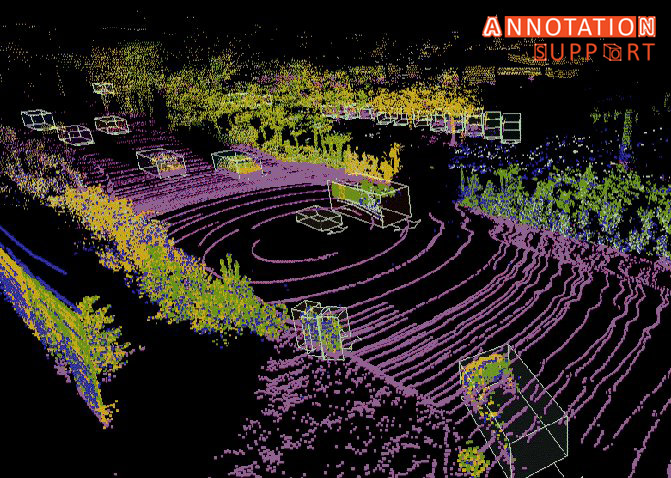
Autonomous vehicles, one of the revolutionary technologies in the contemporary world, are set to drastically transform transportation. Deep at the center of these self-driving car(s) is an artificial intelligence engine which relies greatly on large datasets that are tagged correctly. Self-driving car systems necessarily require data annotation services, which refer to the process of labelling data. By enabling vehicles to understand and interpret their surroundings, data annotation has emerged as the backbone of autonomous driving technology. The Role of Data Annotation in Autonomous Vehicles Perception in self-driving cars is achieved through various systems such as cameras, LiDAR – Light Detection and Ranging, radar and ultrasonic systems. These sensors produce a huge volume of raw data, which should be correctly analysed by AI of the vehicle to make necessary immediate decisions at the moment, including the detection of the obstacles on the way, recognition of traffic signs, and the forecast of the actions of the pedestrians on the crossroad.  Data annotation services enable this process by providing the following key capabilities: Object Detection and Classification: They identify objects that are present in images and videos collected by the vehicle’s vision systems; these include but are not limited to; pedestrians, traffic signs, and other cars. It enables the AI system to effectively identify, categorise and then interact with an object in real time. Semantic Segmentation: This means assigning each pixel of an image with a particular category (e. g., road, sidewalk, vehicle, etc.) so that it can be able to distinguish the various features of the surroundings accurately. Semantic segmentation is important for such tasks as lane detection and avoidance of the obstacles on the road.  Bounding Box and Polygon Annotation: The definition of the shape and position of objects in the image use bounding boxes and polygon. They assist the self-driving cars to estimate the scale and position of the objects in 3D space.  3D Point Cloud Annotation: LiDAR provides a point cloud that is a three-dimensional model of the environment, providing perceptive depth to self-driving cars. Annotators assist in the tagging of this 3D information enabling the vehicle to establish depth and object tracking in real-time as this is imperative for successful navigation in them.  Tracking and Predictive Behaviour Annotation: Vehicles have to navigate through environments that are dynamic that is why it cannot only detect objects, but rather predict their dynamics. By annotating movement trajectories of vehicles, pedestrians, and cyclists, artificial intelligence has a better understanding of the planning behaviour that follows and a better chance at making good decisions for safety’s sake.  Impact of Data Annotation on Autonomous Vehicle Development The quality of annotated data is decisive for the function of the self-driving systems. High quality annotations, which include the checking and validation, make certain that the AI models are able to perform well under various scenario such as different road terrains, weather circumstances and in the urban or rural settings. Some of the ways in which data annotation services are driving advancements in self-driving cars include: Enhanced Safety: Annotation services also contribute to the quality of labelled data, to have a better perception of possible risks that AI will decide and act upon. This is regarded crucial in avoidance of cases of accidents and achieving better control of traffic in areas of high traffic density. Accelerated AI Training: Teaching machines to learn as humans learn with perception intelligence necessitates a big data with carefully annotated data. Annotation services facilitate this process by generating high volumes of labelled data to support further machine learning optimization. Adaptability across Geographies: Self driving vehicles need to be able to respond to traffic signs, signals and other traffic conditions existing globally. Data annotation services provide region-specific data that locates AI systems by identifying particular nation’s attributes like traffic signs or road markings. Real-World Simulations and Testing: To build such environment replicas as well as to perform simulations self-driving algorithms require annotated data. Such tests can be performed in a safer way in such conditions as sudden movements from the pedestrians or adverse weather conditions. Challenges in Data Annotation for Self-Driving Cars Despite its critical role, data annotation for autonomous vehicles faces several challenges: Scale and Complexity: Automated cars produce large volumes of data daily, not least during road trials. Manual annotation of this data at scale, specifically, for datasets such as LiDAR point clouds, can be highly time and resource-consuming and require skilled personnel. Accuracy and Consistency: Hence it important to ensure that the annotations are correct and consistent since any mistake in the labelling process may lead to a wrong AI decision that may compromise on the safety of the vehicle. Edge Cases: Some of the most difficult situations to annotate are: labelling paths that are seldom applied (for example, animals on the road, linked and rapid movements of pedestrians). These situations must be distinctively incorporated into training data to have an assurance that vehicles will respond to the irregularities. Time and Cost: Manual annotation, particularly of 3D and video data, may be expensive and time consuming and hence may not be a feasible option. The requirement to strike a fine line between high quality annotations and speed is still a difficulty for autonomous vehicle organizations. The Future of Mobility and Data Annotation Year by year, self-driving technology remains to be a key aspect in developing autonomous vehicles, and the job of data annotation is an important part of this process. In the future, improvements in AI based annotation tools and methods of active learning could alleviate and decrease the dependency of manual labelling making this process cheaper and faster. Moreover, as the presence of self-driving cars increases in the future to become an integral part of transportation networks, data annotation services would require broader to encompass novel mobility that will be developed, including drone delivery networks and self-driving public transit systems. As mobility goes more toward fully automated systems, acquiring techniques to label progressively complicated data sets will be crucial. Conclusion Self-driving car revolution is incomplete without data annotation

Scroll to Top